

The best time to take psyllium husk depends on what you want it to do. For regularity, take it first thing in the morning or after dinner, at least 1–2 hours before lying down. For blood sugar and appetite, take it 15–30 minutes before a meal. For cholesterol, take it with meals. Whatever the goal, mix each 5 g dose with at least 8 oz (240 mL) of water, keep it 2 hours away from medicines (4 hours for levothyroxine), and take it every day. Daily consistency usually matters more than the exact clock time.
This guide explains why the timing differs, how to build a simple schedule, and what to watch for so you take psyllium safely. It is general information, not medical advice. If you take prescription medicines or have a digestive or swallowing problem, check with your doctor or pharmacist before you start.
How Psyllium Behaves in Your Body
Psyllium husk comes from the seed coat of Plantago ovata, also called isabgol. It is a soluble, gel-forming fibre that your gut bacteria do not ferment much, which is why it tends to cause less gas than some other fibres. Its effects come mainly from what it does physically once it meets water.
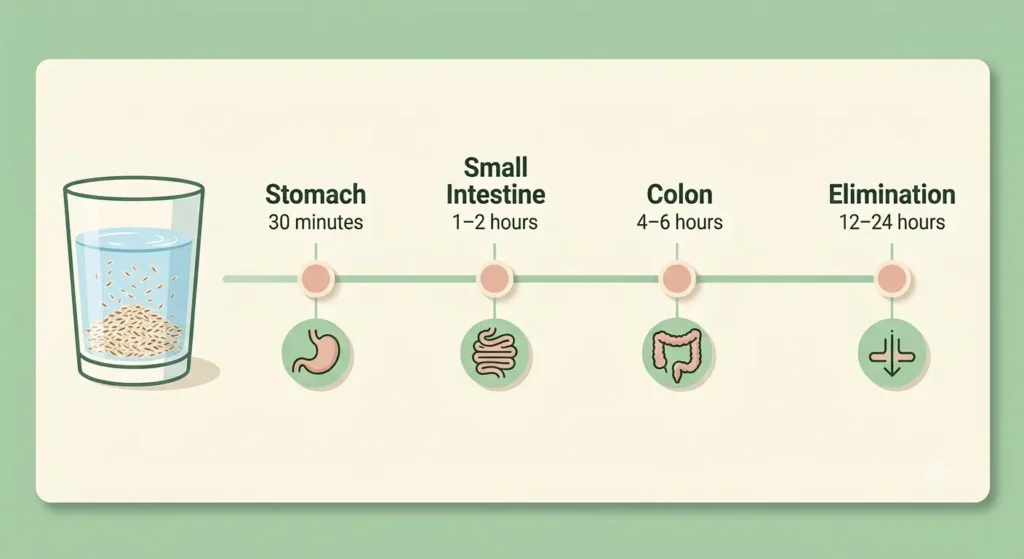
Rough timeline after a dose:
- 15–30 minutes: the husk starts to hydrate and the fluid around it thickens.
- 45–90 minutes: the gel is at its thickest.
- 1–2 hours: the gel moves through the upper small intestine, where it can slow how quickly nutrients are absorbed.
- 4–6 hours: it reaches the large intestine, holds on to water and adds bulk, which encourages movement.
- 12–24 hours: the fibre is fully eliminated, depending on your gut motility and hydration.
These windows are approximate and vary between people. But they explain the timing rules that follow: the gel needs to be in the right place at the right moment, whether that is alongside a meal or on its way to the colon by morning.
Best Time to Take Psyllium Husk by Goal
For Regularity and Constipation
For occasional constipation or irregular stools, total daily intake matters more than strict timing. Pick a time you can stick to. Two routines work well:
- Morning, on waking. Taking psyllium with plenty of fluid soon after you get up works with your body’s natural morning gut activity, which can help establish a regular daytime routine.
- Evening, after dinner. The gel travels through the small intestine overnight and reaches the lower bowel by morning, so some people find waking-up bowel movements easier. Finish the dose at least 1–2 hours before you lie down.
If mornings are rushed, choose the evening. If evenings are unpredictable, choose the morning. Both approaches suit regularity, and switching between them daily undoes the benefit of a steady routine.
For Blood Sugar Support
Research on psyllium and blood sugar generally supports taking it 15–30 minutes before a carbohydrate-containing meal, or with the first bites. The idea is simple: the thick gel forms while food is entering the stomach and small intestine, and it can slow the release of sugar into the blood.
Timing seems to matter here. Taking psyllium an hour after you finish eating is unlikely to change the sugar spike, because the first wave of carbohydrates has already left the stomach. Studies in people with prediabetes and type 2 diabetes have reported improvements in fasting glucose and long-term markers with roughly 10 g a day. If you have diabetes or take glucose-lowering medicine, speak with your healthcare provider first. Psyllium can change how your body handles sugar and how some tablets are absorbed, so your treatment plan may need to be adjusted.
For Appetite Control and Weight Management
To use psyllium as a fullness aid, take it about 20–60 minutes before your larger meals, most often before breakfast or the main meal of the day. The husk swells in the stomach, which can make you feel fuller sooner and may lead to smaller portions. Trials in overweight and obese adults have reported modest reductions in body weight and waist size over several months at around 10 g a day.
Psyllium is a support tool, not a shortcut. It works best alongside balanced meals, regular movement and enough fluid. Anyone expecting rapid fat loss from fibre alone will likely be disappointed.
For Cholesterol
Psyllium can lower LDL (“bad”) cholesterol, and the timing advice differs from the goals above: take it with meals, especially meals that contain fat. Fat triggers the release of bile acids, and psyllium gel can bind some of them so they leave the body in stool. The liver then draws on circulating cholesterol to make replacement bile acids.
Two points stand out from the research. First, splitting the daily dose across two or three main meals captures more bile release, though total daily intake remains the biggest factor. Second, a crossover study comparing morning and evening dosing found similar cholesterol-lowering effects when the total daily amount stayed the same, at roughly 10–12.7 g a day. You can read that study on the NIH’s PubMed Central: effect of time of administration on cholesterol-lowering by psyllium. So for cholesterol, taking it every day with meals matters more than picking a perfect hour.
Morning or Night? A Quick Comparison
| Morning | Evening | |
|---|---|---|
| Best for | Blood sugar, fullness before breakfast, morning routine | Overnight transit, easier waking bowel movement |
| Timing | On waking, or 15–30 min before breakfast | After dinner, 1–2 hours before lying down |
| Watch out for | Medicine taken at the same time | Lying down too soon after a dose |
| Consistency tip | Pair with a habit such as brushing teeth | Pair with clearing the dinner table |
If you are unsure, start with one dose in the morning. You can add a second dose in the evening later.
Medicines and Supplements: Keep Them Apart
This is the part people most often overlook. Psyllium gel can physically trap other substances and slow their absorption, so it can reduce how much of a medicine or supplement you actually absorb.
A common general rule is to take medicines and supplements at least 2 hours before or 2 hours after psyllium. Some medicines need more care:
- Levothyroxine (thyroid medicine): guidance suggests separating it from psyllium by about 4 hours, because fibre has been shown to reduce its absorption. A practical routine is levothyroxine on waking, breakfast 30–60 minutes later, and psyllium at midday or in the evening. See the NIH-hosted PubMed record: effects of fibre supplements on levothyroxine absorption.
- Digoxin: a 2–4 hour gap is commonly advised.
- Lithium: keep at least 2 hours between doses.
- Diabetes tablets: keep a 2-hour gap, because the combined effect on glucose can be unpredictable.
- Extended-release medicines: allow more than 2 hours, since faster gut transit can carry the tablet past its absorption zone.
- Iron and calcium supplements: a 2-hour gap helps preserve absorption.
Medicine schedules are personal and sometimes strict. Your pharmacist can help you map psyllium into your day. For more on this topic, see our guide on psyllium husk and drug absorption timing.
How to Take Psyllium Safely
The main risk with psyllium is not the fibre itself but taking it without enough fluid. It swells quickly, and dry or half-mixed powder can clump in the throat or gullet and cause choking or blockage. Follow these rules every time.
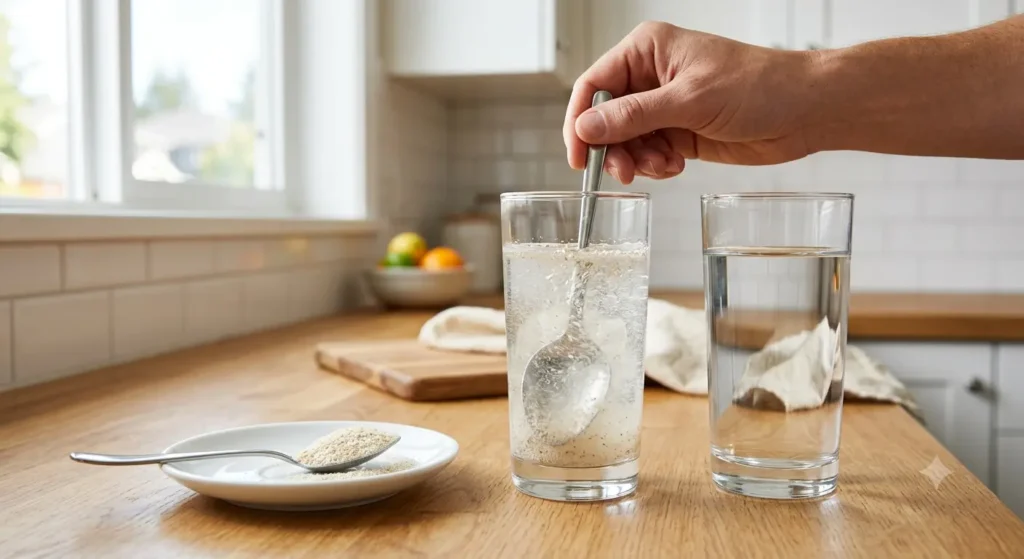
- Use enough liquid. Mix each 5 g dose in at least 8 oz (240 mL) of water or another drink.
- Drink it right away. Stir and swallow promptly, before the mixture thickens into a gel.
- Follow with more fluid. Have another glass of water, and aim for around 2.0–2.5 litres of total fluid across the day.
- Stay upright. Do not take a dose right before lying down or going to sleep. Stay sitting or standing for at least 30–60 minutes afterwards.
- Start slowly. Begin with 3–5 g once a day for the first week, then increase by 3–5 g a week if you tolerate it, working toward a typical range of 10–20 g a day split into two or three doses.
- Do not use it if you have certain conditions. Psyllium should not be used with a known bowel obstruction, faecal impaction or narrowing of the gullet. If you have trouble swallowing, ask a doctor before trying it.
Gas, cramping and bloating are common at first. They usually ease when you go slowly, drink enough water and give your gut time to adapt.
Sample Daily Schedules
Use these as starting points and adjust with your healthcare provider.
Regularity routine. Take 5–10 g in the morning on waking with a full glass of water, or after dinner at least 1–2 hours before bed. Drink water through the day.
Blood sugar and appetite routine. Take 5 g about 15–30 minutes before breakfast and another 5 g before dinner, building up gradually toward 10 g a day. Keep medicines 2 hours away from each dose.
Cholesterol routine. Take 5 g with breakfast and 5 g with dinner, aiming for roughly 10–12 g a day total. Keep it consistent.
Combined routine. Take 5 g before breakfast and 5–10 g after dinner, so you get pre-meal support in the morning and overnight colon support in the evening.
Add or reduce doses slowly, and never jump straight to a full daily amount.
Does the Quality of Psyllium Matter?
Yes, and it affects how a dose behaves. Purity, particle size and freshness influence how quickly the husk hydrates, how smooth it mixes and how consistent your dose is. Finer powders disperse faster in water, while whole husk hydrates more slowly. Look for products with a clear ingredient list, no added sweeteners or fillers, and a supplier who can share testing information.
As a manufacturer and exporter in Unjha, Gujarat, Mantra Psyllium Industries supplies psyllium husk and powder to food, nutraceutical and pharmaceutical customers. If you are formulating or sourcing, our psyllium husk powder page explains the range.