
Psyllium husk is exported from India through a fixed sequence: the exporter holds an Import Export Code (IEC), an FSSAI licence and an export council registration. It sources Plantago ovata seed from Gujarat and Rajasthan, processes it into sterilised husk or powder, tests each lot and issues a Certificate of Analysis, obtains a phytosanitary certificate, packs the product in moisture-proof bags, clears customs under HS code 12119032, and ships by sea, mostly through Mundra or Nhava Sheva. Each step affects whether your container clears customs, meets your specification and arrives in good condition.
This guide walks through the whole process in the order it happens. It is written for importers, formulators and procurement teams who want to understand what a reliable Indian supplier should be doing behind the scenes, and what to check at every stage.
Why the Export Process Starts in India
India controls roughly 80% to 90% of global psyllium supply. A few neighbouring regions, such as parts of Pakistan, grow small quantities, but limited processing infrastructure keeps them from competing at international scale. Global demand is projected to grow at around 7% to 8% a year, driven by interest in plant-based fibre, functional foods and pharmaceutical ingredients.
The United States is the largest importer by value. Germany, the United Kingdom and France are key European destinations, alongside Canada and Australia. Bangladesh and Saudi Arabia take large bulk volumes. Because the whole world leans on one country’s harvest and processing capacity, understanding how Indian exporters work is a practical part of supply planning, not background reading.
Step 1: Sourcing Seed from the Gujarat–Rajasthan Belt
Plantago ovata is a winter (rabi) crop that needs dry, clear weather while the seed matures. Cultivation therefore sits in India’s semi-arid north-west. Gujarat contributes about 70% to 80% of national raw crop yield, with Banaskantha, Mehsana and Patan among the key districts. Rajasthan is second at roughly 15% to 20%, centred on Jodhpur, Barmer and Nagaur, and Madhya Pradesh supplies most of the remainder.
The town of Unjha in Gujarat is the commercial hub and the main price-discovery market for both raw seed and processed husk. Exporters buy seed at auction yards and through agents, and the price they pay depends on the season’s yield, weather at harvest and seed purity.
Because this belt is small, one unseasonal rain or heatwave in the February–March harvest window can damage seed coats, lower swelling capacity and push prices up. Good exporters manage this by building buffer stocks and using contract farming in different micro-climates. When you assess a supplier, ask how they secure seed in a poor crop year. It tells you how reliable their supply will be.
Step 2: Cleaning, De-husking and Milling
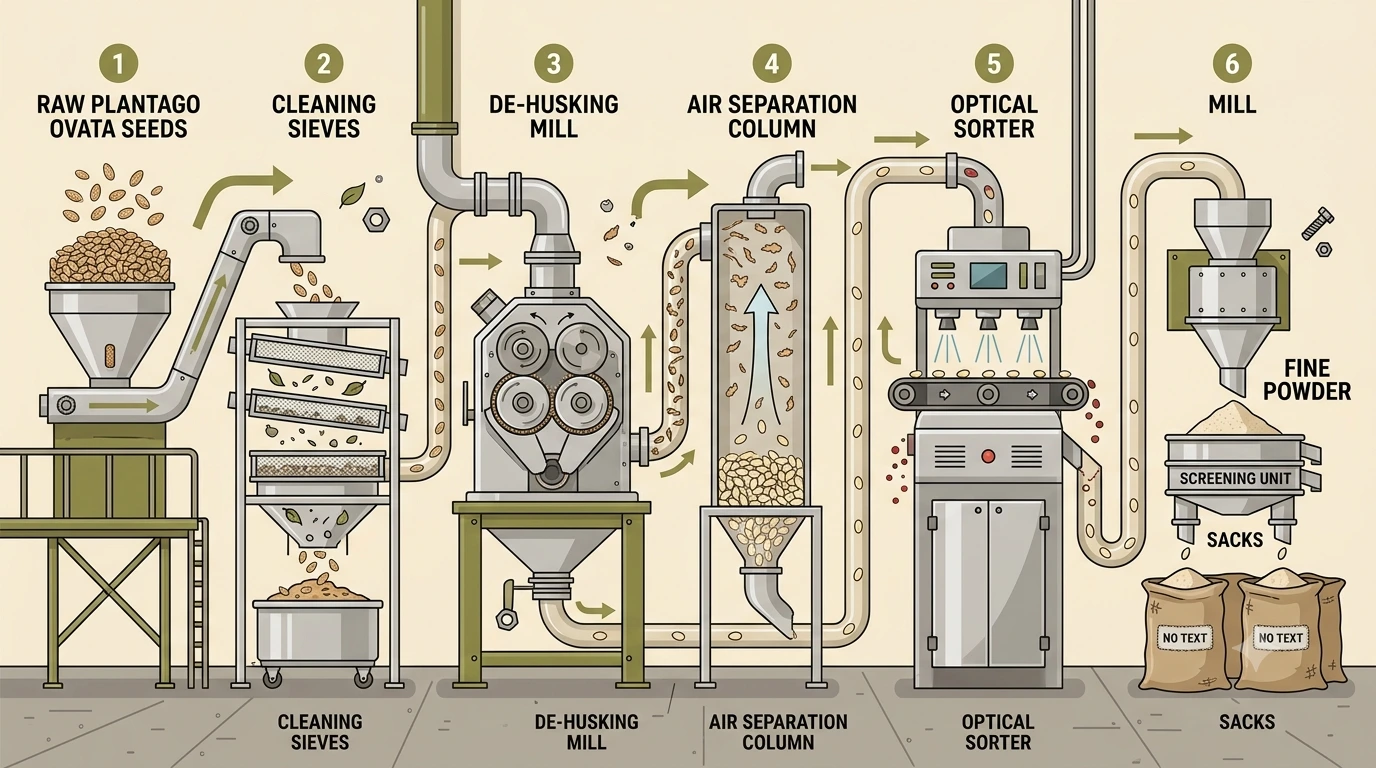
Turning seed into husk takes several mechanical stages.
- Pre-cleaning. Raw seed arrives with sand, stones and plant debris. Sieves, aspirators and de-stoners clean it before de-husking starts.
- De-husking. Cleaned seed passes through mills fitted with corrugated emery rolls or rubberised disks. Controlled friction strips the outer husk from the hard inner kernel without crushing the kernel.
- Air separation. The mixture of husk, unhusked seed and kernels goes through winnowing and air classification. Husk is lighter than kernel, so air lifts it away.
- Gravity refining. Several passes over gravity separators and optical sorters refine the husk fraction and remove dark specks.
- Milling and sieving. Whole husk can be packed as flakes, or ground into powder and screened into particle sizes, typically from 40 mesh to 100 mesh.
Finer powders in the 60–100 mesh range are in strong demand for beverages and pharmaceutical uses because they disperse quickly in liquid. Coarser fractions and whole husk suit slower-hydrating applications. Batches are then blended to hit target purity and swelling benchmarks. If you want to compare mesh options against your own process, our psyllium husk powder page is a useful starting point.
Step 3: Sterilisation and Contaminant Control
Psyllium is harvested close to the soil and absorbs moisture from the air, so raw husk carries a natural microbial load, including aerobic bacteria, yeasts, moulds and possible pathogens such as Salmonella and E. coli. It has to be treated before it can be exported.
Two methods are used:
- Ethylene oxide (EtO). It sterilises effectively without exposing the mucilage to moisture, but it leaves residues such as ethylene chlorohydrin. The US FDA still accepts regulated EtO treatment within strict limits, while the European Union sets residue limits at or near the limit of analytical detection, which in practice rules it out for EU-bound food.
- Continuous steam sterilisation. Dry steam briefly treats the husk, neutralising pathogens while protecting the structure and swelling capacity of the mucilage. It leaves no chemical residue.
Steam-treated husk has become the preferred route for European and organic buyers, and processors who rely only on EtO chambers risk losing access to those markets. Steam lines cost more to install, but they give one product that suits several regulators. For any importer, the safest contract term is simple: state which sterilisation method is acceptable, and prohibit EtO if you sell into the EU or into organic channels.
Step 4: Grading, Testing and the Certificate of Analysis
Purity is the main commercial grade. Suppliers commonly sell 85%, 95%, 98% and 99% purity, where the figure reflects the proportion of clean husk versus kernel fragments and foreign matter.
| Grade | Typical use |
|---|---|
| 85% | Industrial binders, low-cost feed |
| 95% | Food-grade fibre additives, commercial baking |
| 98% | Standard export benchmark for food and retail packaging |
| 99% | Pharmaceutical-grade and nutraceutical products |
Beyond purity, buyers look at swelling index, moisture, colour and mesh. Exporters usually work with NABL-accredited third-party laboratories to issue a Certificate of Analysis (CoA) covering:
- Physical parameters: mesh size, colour and swelling index.
- Chemical parameters: heavy metals, pesticide residues and moisture.
- Microbiological counts: total plate count, yeast and mould, and pathogens.
Treat the CoA as a lot-specific document. Ask for the result for the batch you are buying, and compare it against your written specification before you agree to ship.
Step 5: Registrations, Licences and Export Paperwork
An Indian company cannot simply pack a container and send it. It needs a layered regulatory footprint.
- Import Export Code (IEC). Issued by the Directorate General of Foreign Trade (DGFT), it is the basic requirement for any exporter.
- FSSAI licence. A central licence from the Food Safety and Standards Authority of India, together with adherence to Good Manufacturing Practices.
- RCMC. A Registration-cum-Membership Certificate from the relevant Export Promotion Council. Psyllium husk is typically handled under the Shellac and Forest Products Export Promotion Council (SHEFEXIL), although some processors also hold registrations with the Spices Board or APEDA.
- Phytosanitary certificate. Every consignment needs one, issued by a plant quarantine station under the Directorate of Plant Protection, Quarantine & Storage, confirming the shipment is free from quarantine pests, weed seeds and soil contamination. You can read about the certification process on the Directorate of Plant Protection, Quarantine & Storage website.
On shipment day, the standard document set also includes the commercial invoice, packing list, bill of lading or airway bill, certificate of origin where required and the CoA. Ask your supplier to share the draft documents before loading so mistakes are caught early.
Step 6: Meeting Destination-Market Requirements
Each importing country adds its own checks, and the right supplier will already know them.
| Region | Authority | Key requirements |
|---|---|---|
| United States | US FDA | Prior Notice, FSVP compliance, heavy metal testing (lead, arsenic, cadmium), EtO residue limits |
| European Union | EFSA / EU customs | EtO residues at or near detection limit, strict aflatoxin limits, no Salmonella in 25 g samples |
| Middle East (GCC) | Regional food authorities such as SFDA and ESMA | Halal certification, CoA showing moisture and purity, with moisture below 12% |
| Australia | Department of Agriculture, Fisheries and Forestry | Biosecurity inspection, moisture verification, phytosanitary clearance |
If you import into the United States or Germany, it helps to work with a supplier who already ships there regularly. You can see how we support these markets on our pages for a psyllium husk supplier in the USA and a psyllium products supplier in Germany.
Organic Psyllium: NPOP, TraceNet and MRAs
Organic psyllium is a growing, higher-margin segment. It requires no synthetic pesticides in the field and no chemical fumigants such as EtO or methyl bromide after harvest. India’s National Programme for Organic Production (NPOP), governed by APEDA, tracks every organic lot through the TraceNet platform. Each organic shipment must carry a TraceNet-generated Transaction Certificate that follows the commodity from NPOP-certified farm clusters through accredited processors.
India has also signed Mutual Recognition Arrangements (MRAs) for organic equivalence. According to the research, agreements are active with the European Union, Switzerland, Great Britain and Taiwan, and one with Australia was signed in September 2025. Under an MRA, the importing authority accepts NPOP certification without demanding a second local organic inspection, which reduces duplicate certification costs and speeds clearance. If organic is part of your plan, confirm which MRA applies to your destination before you place an order.
Step 7: Packaging for Long Sea Freight
Psyllium husk is hydrocolloidal, so exposed husk quickly absorbs humidity, which leads to clumping, colour loss and fungal growth. Export packaging has to be moisture-proof and airtight. Common formats are:
- Multi-wall paper bags with poly-liners: 20 kg or 25 kg kraft paper laminated with food-grade PE or PP liners, widely used for 95% and 98% husk headed to repackers or food plants.
- FIBC (super sacks): UV-stabilised woven polypropylene bags holding 500 kg to 1,000 kg, with bottom-spout discharge and moisture-barrier liners, suited to large pharmaceutical and industrial buyers.
- Fibre drums with inner poly-seals: used for ultra-pure 99% pharmaceutical powder to protect against compaction and humidity.
Decide your format at the enquiry stage because it affects handling at your plant, not just cost. If your line takes bag-by-bag feeding, 25 kg bags may be easier. If you process large batches, jumbo bags cut labour.
Step 8: Customs, HS Code and Logistics
Psyllium husk is recorded under Chapter 12 of the Harmonised System. For Indian exports the dedicated eight-digit code is ITC(HS) 12119032 (Psyllium husk, isobgul husk). Other codes appear in trade data for variants, including 12119029 for some bulk husk shipments and 12119098 or 12119099 for specialised powders, so your exporter and your customs broker should agree on the right heading before booking. Under Indian foreign trade policy, exports under 12119032 are classed as “Free”, meaning no export ban, quota or Minimum Export Price applies. You can read the classification in the DGFT ITC(HS) notification. Exporters may also claim duty remission under the RoDTEP scheme, which helps offset taxes that are not otherwise refunded.
Ocean freight carries over 95% of export volume. Mundra Port in Gujarat handles the largest share because it sits close to the processing clusters in Unjha and Banaskantha. Nhava Sheva (JNPT) in Maharashtra is a secondary gateway, mainly for processed pharmaceutical-grade powders. Sabarmati Inland Container Depot acts as a rail hub where containers are stuffed, sealed, customs-cleared and railed to the port. For Bangladesh, trucks cross by road at Petrapole.

Common Mistakes Buyers Make
A few mistakes come up repeatedly in psyllium trade:
- Vague specifications. “Pharma grade” means nothing without a monograph, mesh, swelling target and test method written into the contract.
- Ignoring sterilisation method. Buyers assume all lots are treated the same. EU and organic buyers need steam-sterilised, EtO-free material.
- Skipping the lot-level CoA. A generic spec sheet from a brochure is not proof of the batch you receive.
- Choosing packaging late. Bag or drum format changes handling costs and moisture protection.
- Buying without a documents check. Ask for a draft phytosanitary certificate, CoA and invoice before loading.