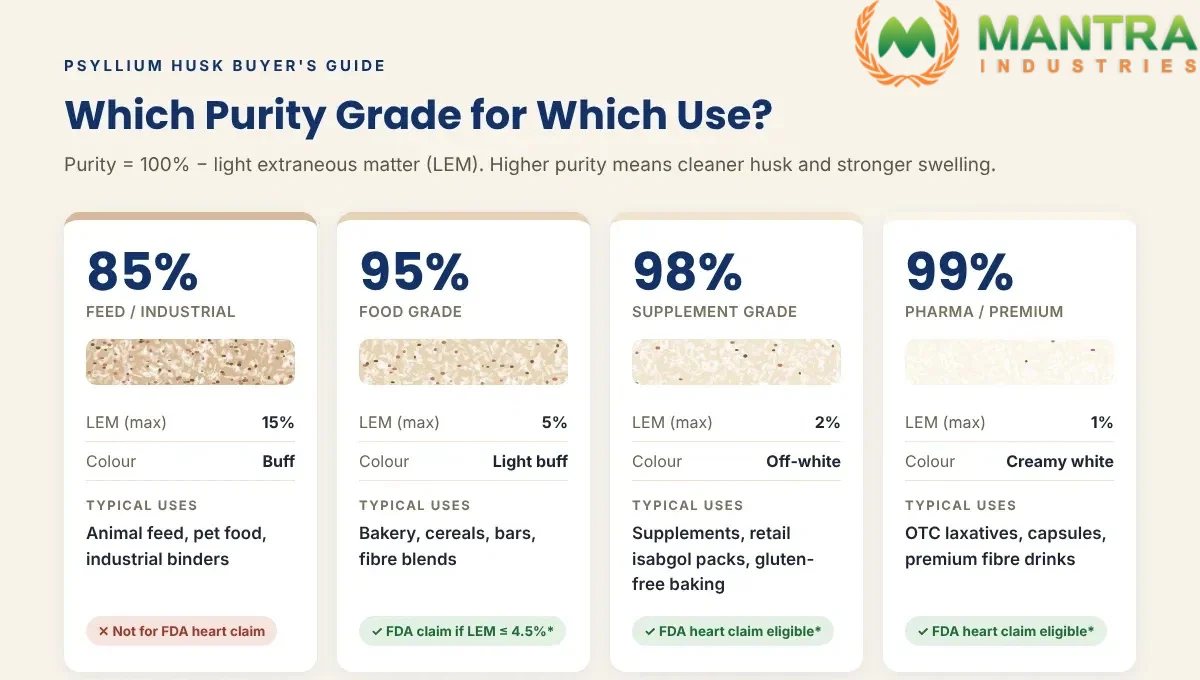
Psyllium husk is traded in four standard purity grades: 99%, 98%, 95% and 85%. The percentage tells you how much of the product is pure husk and how much is light extraneous matter, such as fine seed particles, pink husk and other light material. 99% and 98% are used for pharmaceuticals, supplements and premium food; 95% for food manufacturing and blends; 85% mainly for animal feed and industrial use. If you sell fibre products in the USA with the FDA heart-health claim, the husk must be at least 95% pure.
This guide explains what each grade means, how they differ in specification, and how to choose the right one for your product.
What Does "Purity" Mean in Psyllium Husk?
In the psyllium trade, purity is calculated as:
Purity (%) = 100% − Light Extraneous Matter (%)
So:
- 99% psyllium husk contains up to 1% light extraneous matter.
- 85% psyllium husk contains up to 15% light extraneous matter.
Light extraneous matter (LEM) is lightweight material that stays with the husk after milling and cleaning: fine fragments of the seed, pinkish husk particles and other light impurities. It isn't harmful, but it dilutes the fibre content and lowers the swelling power.
Heavy extraneous matter (HEM) is heavier material, such as sand, soil and small stones.
Higher purity takes more sieving, aspiration and grading, and gives a lower yield from each kilogram of seed. That's why higher grades cost more.
Psyllium Husk Grades Compared: Mantra Psyllium Specifications
The table below shows the specification Mantra Psyllium Industries supplies for each grade. The full specification, including microbiology, is on our psyllium husk page. Agree the exact values for your order in your contract.
| Parameter | 99% | 98% | 95% | 85% |
|---|---|---|---|---|
| Purity (min) | 99% | 98% | 95% | 85% |
| Light extraneous matter (max) | 1% | 2% | 5% | 15% |
| Heavy extraneous matter (max) | 1% | 1% | 1% | 1% |
| Acid-insoluble ash (max) | 1% | 1% | 1% | 1% |
| Total ash (max) | 4% | 4% | 4% | 4% |
| Moisture (max) | 12% | 12% | 12% | 12% |
| Swell volume (min) | 50 ml/g | 45 ml/g | 40 ml/g | 35 ml/g |
| Salmonella | Absent | Absent | Absent | Absent |
| Colour | Super white | White | Pale buff | Beige creamy |
Swell volume measures how much the husk swells in water. It is the key functional test for psyllium, because swelling is what makes it work as a bulk-forming fibre and as a binder in food. The USP methods measure psyllium content using swell volume. A common minimum in USP-based specs is 40 ml/g, and premium 99% grades are often 50 ml/g or more. Always ask for the swell volume on the Certificate of Analysis (COA).
Which Grade Should You Buy? (By Application)
| Your product | Recommended grade | Why |
|---|---|---|
| OTC laxatives, pharmaceutical fibre products | 99% (USP grade) | Highest fibre and swell, tightest limits, meets pharmacopoeia requirements |
| Dietary supplements: capsules, sachets, fibre drinks | 99% or 98% | Clean appearance, strong swelling, consistent dosing |
| Retail psyllium husk packs (isabgol) | 98% or 99% | Consumers notice colour and grit; higher grades look and taste cleaner |
| US foods with the FDA heart-health claim | 95% minimum | Required by FDA rules (see below) |
| Gluten-free bakery, bread and pasta | 95–98% | Good binding and water absorption at a lower cost than 99% |
| Breakfast cereals, bars, functional foods | 95–98% | Balance of performance and cost |
| Animal feed, pet food | 85% (or 95% for premium pet food) | Fibre benefit at the lowest cost; appearance matters less |
| Industrial uses (binders, thickeners, erosion control) | 85% | Function matters more than appearance |
Grade by Grade
99% Psyllium Husk – Pharmaceutical and Premium Grade
The cleanest grade, with up to 1% light extraneous matter. It has the highest fibre concentration and the strongest swelling, and is usually supplied to USP specifications. It's the standard choice for OTC laxative and fibre brands, premium supplements, and psyllium husk powder for capsules and drink mixes.
Choose it if: you make pharmaceuticals or supplements, you sell under your own brand where appearance matters, or your customer's spec says USP.
98% Psyllium Husk – Supplement and Food Grade
Very close to 99% in performance, with slightly more light material (up to 2%). Many supplement, retail and food brands use 98% because it offers nearly the same quality at a lower price.
Choose it if: you need high quality but want to save compared with 99%, for example for retail isabgol packs, fibre supplements or premium gluten-free baking.
95% Psyllium Husk – Food Manufacturing Grade
Up to 5% light extraneous matter. It still meets the FDA's minimum purity for the psyllium heart-health claim, which makes it popular with US food manufacturers. It works well in bakery, cereals and fibre blends where the husk is mixed with other ingredients.
Choose it if: you make bread, cereals, bars or blends, or you need the FDA claim at the lowest qualifying cost.
85% Psyllium Husk – Feed and Industrial Grade
Up to 15% light extraneous matter, with a darker, buff colour and lower swelling power. It's the most economical grade and is widely used in animal feed, pet food and industrial applications.
Choose it if: your product is for animals or industrial use, and price matters more than appearance.
The FDA 95% Rule for Heart-Health Claims (USA)
If your product will carry the US FDA health claim linking psyllium soluble fibre to a reduced risk of coronary heart disease, the husk must meet the rules in 21 CFR 101.81:
| Requirement | Rule |
|---|---|
| Purity | No less than 95% |
| Protein | 3% or less |
| Light extraneous matter | 4.5% or less |
| Heavy extraneous matter | 0.5% or less |
| Combined extraneous matter | No more than 4.9% |
| Test methods | U.S. Pharmacopeia (USP) methods |
| Soluble fibre per serving | At least 1.7 g soluble fibre from psyllium husk per reference amount |
| Daily intake the claim is based on | 7 g or more of soluble fibre from psyllium husk per day |
What this means for buyers: 85% husk can't be used for this claim. 95% husk can, if it also meets the protein and extraneous matter limits. Many US brands choose 98% or 99% to stay comfortably inside the limits. Ask your supplier for a COA showing purity, LEM and HEM tested by USP methods.
This is general information, not legal advice. Check your label claims with a US regulatory consultant.
Psyllium Husk vs Psyllium Husk Powder: Which Grades Are Available?
Psyllium husk powder is made by milling the husk, so the powder's purity follows the grade of the husk used. Powders are commonly supplied in the same four grades (99%, 98%, 95%, 85%) and in mesh sizes of 40, 60, 80 and 100 mesh.
| Mesh | Texture | Typical use |
|---|---|---|
| 40 mesh | Coarse | Bakery, cereals, feed |
| 60 mesh | Medium | Food blends, bakery |
| 80 mesh | Fine | Supplements, drink mixes |
| 100 mesh | Very fine | Capsules, smooth-dispersing drinks |
Tip: for capsules and smooth drinks, choose 99% purity + 80–100 mesh. For bread and bakery, 95–98% + 40–60 mesh is usually enough.
See our psyllium husk powder for available grades and mesh sizes.
How to Check the Purity You're Paying For
- Ask for a COA for every lot. It should show purity, light and heavy extraneous matter, swell volume, moisture, ash, acid-insoluble ash and microbiology.
- Check the test method. "USP" on the COA means the tests follow the U.S. Pharmacopeia methods, which is the most widely accepted basis.
- Approve a pre-shipment sample. Compare its colour, feel and swelling with your approved standard sample.
- Test on arrival. For large or regular orders, send a sample to your own lab or an independent lab.
- Look at the colour. Higher grades are whiter and more uniform. Visible pinkish or dark particles point to more light extraneous matter. A visual check is only a first impression, though, and doesn't replace lab testing.
Common Mistakes Buyers Make
- Buying 85% for human consumption products to save money. Customers notice the darker colour and grit, and the product swells less.
- Comparing prices across different grades. A "cheap 99%" quote may really be a 98% or 95% product. Always compare like for like, using the COA.
- Ignoring swell volume. Two lots with the same purity can perform differently. Swell volume shows the real fibre function.
- Forgetting microbiology. For supplements and ready-to-eat foods, also specify total plate count, yeast and mould, E. coli and Salmonella, or ask for steam-sterilised husk.
- Not matching the FDA rule. If you plan to use the heart-health claim, make sure the spec meets the 95% purity and extraneous-matter limits before you order.
Buyer's Checklist Before Ordering
- Purity grade: 99% / 98% / 95% / 85%
- Form: whole husk or powder (and mesh size)
- Organic or conventional
- Specification: purity, LEM, HEM, swell volume, moisture, ash, acid-insoluble ash
- Microbiology limits (and steam sterilisation if needed)
- Pesticide residue and heavy metal limits for your market
- Certifications needed: organic, Kosher, Halal, gluten-free, non-GMO
- Sample approved and COA received
- Packaging, private label, quantity, Incoterm and destination port
Frequently Asked Questions
What does 99% purity mean in psyllium husk?
It means at least 99% of the product is pure psyllium husk and no more than 1% is light extraneous matter, such as fine seed particles and pink husk. Purity is calculated as 100% minus the light extraneous matter.
Which psyllium husk grade is best?
There is no single "best" grade. 99% is best for pharmaceuticals and premium supplements, 98% for supplements and retail packs, 95% for food manufacturing and FDA heart-health claims, and 85% for animal feed and industrial use. Choose the grade that matches your application and budget.
Is 95% psyllium husk good enough for food?
Yes. 95% psyllium husk is widely used in bakery, cereals and fibre blends. It is also the minimum purity the US FDA allows for foods carrying the psyllium heart-health claim.
Can 85% psyllium husk be used for human consumption?
It is mainly used for animal feed and industrial purposes. For human food and supplements, most buyers choose 95% or higher, for better appearance, swelling and compliance with food standards.
Why is 99% psyllium husk more expensive?
Reaching 99% purity takes more sieving, aspiration and grading, and a smaller share of each kilogram of seed ends up as top-grade husk. The extra processing and lower yield raise the cost.
Is psyllium husk powder available in all purity grades?
Yes. Psyllium husk powder is made by milling the husk, so it is usually available in the same grades (99%, 98%, 95%, 85%) and in different mesh sizes, typically 40, 60, 80 and 100 mesh.
What is swell volume, and why does it matter?
Swell volume measures how much psyllium husk swells when mixed with water, in ml per gram. It shows how well the fibre will work as a bulking agent or binder. A common minimum in USP-based specifications is 40 ml/g, and premium grades are often higher.
Get the Right Psyllium Grade for Your Product
Mantra Psyllium Industries manufactures and exports psyllium husk, psyllium husk powder and psyllium seed from Unjha, Gujarat, the heart of India's psyllium trade. Tell us your application, target market and specification, and our team will recommend the right purity grade and send you a sample with a full COA.
Request a quote for psyllium husk →
Also read: